
Auditioning for the Mob

“He who marries the spirit of the age will find himself a widower in the next.”
Grievance used to be a mood, not a defining pathology. For most of my life, a large segment of the voting public harbored fierce grievances over specific issues like the death penalty or abortion. Today, however, we are treated to the exhausting spectacle of an electorate that is furious about absolutely everything, all of the time.
It is a profound rarity to hear a kind word spoken about any public servant. We ignore the boring reality that there are literally hundreds of quiet, unspectacular legislators whose names we do not know precisely because they are actually doing the tedious work of governance, rather than auditioning for the evening news.
But we created these attention whores, didn’t we?
For the first time in human history, the siren song of narcissism has undressed each and every one of us - including our “leaders.” We post, snap, and Substack our every passing thought (the irony here is not lost on me, I assure you). And then we sit, staring at a piece of glass to see who is paying attention.
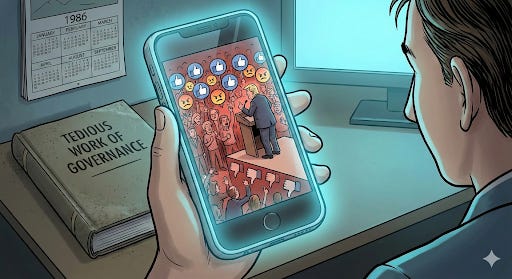
Unlike a mere forty years ago, we labor under the delusion that a half-dozen strangers should care about our inner monologue. If we cannot summon a small digital mob to “like” or “share”our latest grievance, we suffer the existential dread that we simply do not matter, or, in the case of a politician, that they will lose reelection. It is a completely poisonous logic.
A mere 40 years ago, if we had a thought on a Tuesday afternoon, we didn't have the machinery to broadcast it to the globe. And if we had a profoundly stupid idea, we couldn't inflict it on more than our immediate friends or the person on the other end of a phone. In other words, we had the thought, we muttered it to ourselves, and the thought stayed with us. The world spun on, entirely unbothered. Our intrinsic value as a human being did not plummet because we lacked 25 retweets and a flurry of sympathetic emojis.
Today, it is the attention that matters, not the content. Populist political charlatans prey on the attention addiction and wield social media as a cudgel against serious politicians to make them abide by the fringes of the ideological spectrum. They’ve forgotten that “[h]e who marries the spirit of the age will find himself a widower in the next.”
By exchanging our responsibility to engage in dialogue with those on the other side for digital validation, we have surrendered our politics to the loudest, emptiest vessels in the room. A democracy cannot survive when we view politics not as the rational management of society, but as a vanity mirror in which to admire our own grievances.
Well said and such truth.